



Apheresis Procedures in Our Clinics
Hemoperfusion
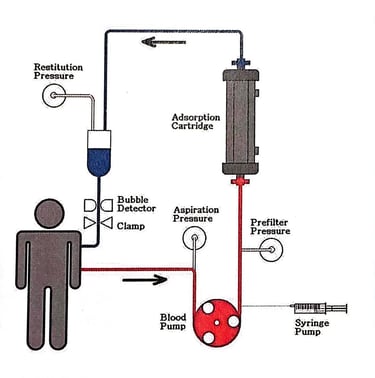
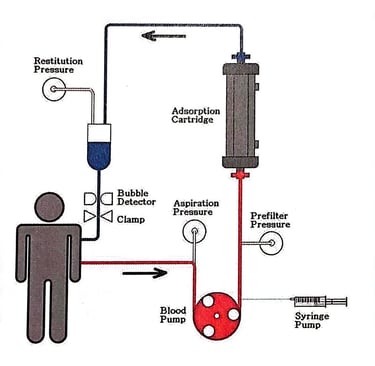
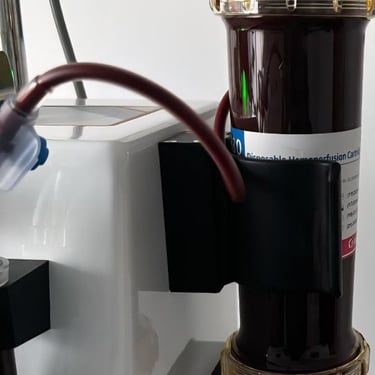
Hemoperfusion is used for severe inflammation, sepsis, medication overdoses, poisoning, severe kidney disease, liver failure, rhabdomyolysis, severe acute pancreatitis, and hyperlipidemia. Unlike DFPP, where plasma is passed through a fractionation filter, hemoperfusion does not separate plasma; instead, the whole blood flows through a specialized adsorption cartridge with multiple functions.
Hemoperfusion effectively removes both endogenous and exogenous molecules, including inflammatory mediators, cytokines, bilirubin, metabolic toxins, overdosed or residual medications, poisons, accumulated β2-microglobulin, excess parathyroid hormone, leptin, and other protein-bound toxins, as well as triglycerides, cholesterol in severe pancreatitis, and myoglobin.
Double Filtration Plasmapheresis (DFPP)
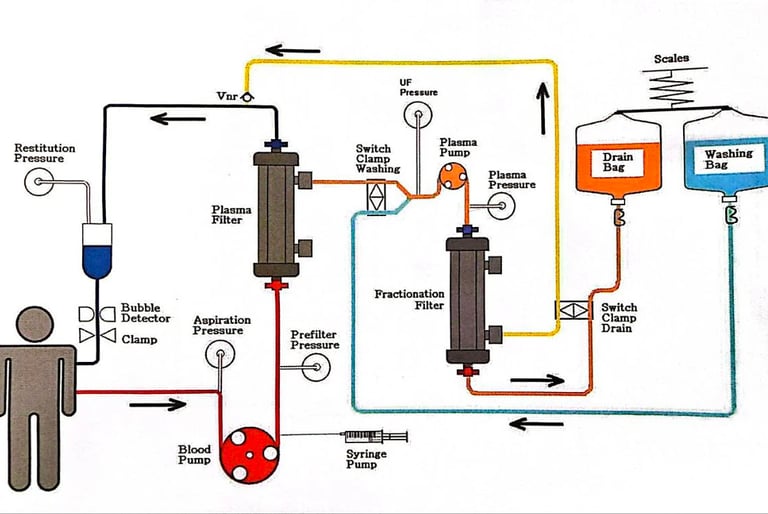
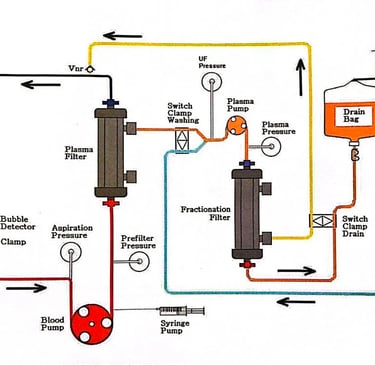
Double Filtration Plasmapheresis (DFPP) is a modern, targeted blood purification therapy with scientifically proven effectiveness in the treatment of numerous medical conditions. It involves the selective removal of harmful substances — such as autoantibodies, inflammatory mediators, lipoproteins, and toxins — while preserving essential plasma components. DFPP is an internationally recognized medical therapy, included in major evidence-based treatment guidelines such as: the American Society for Apheresis (ASFA) guidelines, the German Standard der Therapeutischen Apherese, the clinical standards of the Japanese Society for Apheresis.
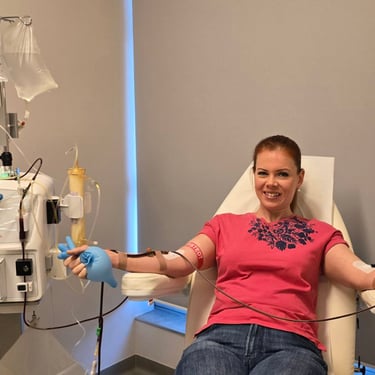
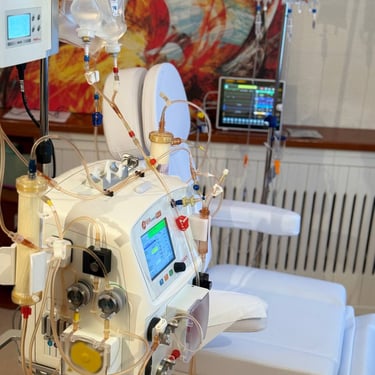
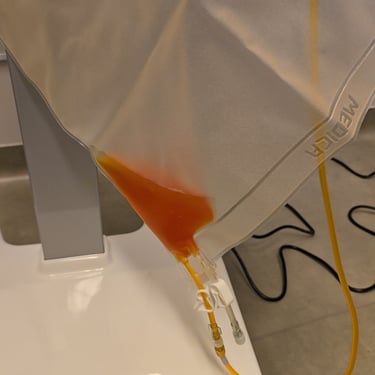
DFPP is a closed-loop process. Thanks to our state-of-the-art technology, only a very small volume of blood (approximately 250 ml) is processed in the device at any time. This ensures that you do not experience a deficiency of essential blood components or an electrolyte imbalance. At the end of the treatment, you lose only about 150 ml of concentrated pathological plasma, which can be sent to a laboratory for diagnostic analysis upon request.
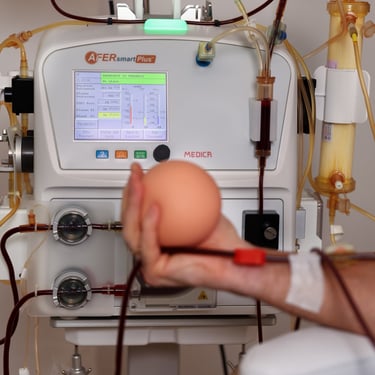
Because we use filters to separate plasma and red blood cells, a high blood flow is not required. Therefore, in most cases, we can use peripheral veins in the forearm, similar to an intravenous infusion.
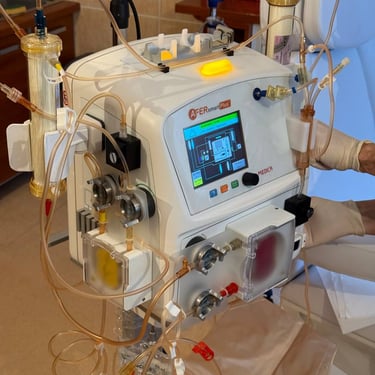
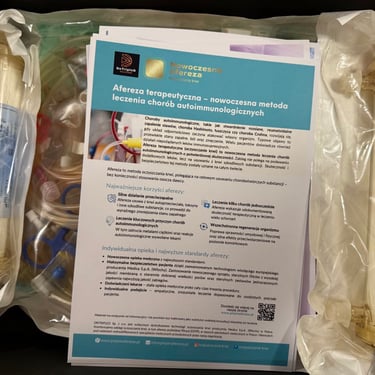
Thanks to advanced technology, there is no risk of infection, as the blood does not come into direct contact with any device parts. It flows exclusively through sterile single-use kits and filters, which can be unpacked in front of you before the treatment begins, if desired.
The information provided is for general informational purposes only and does not replace individual medical advice or treatment.


Watch our videos on YouTube
Frequently Asked Questions About DFPP, Plasmapheresis and Therapeutic Apheresis
Is Double Filtration Plasmapheresis (DFPP) an established and well-studied medical procedure?
Yes. Double Filtration Plasmapheresis (DFPP) is an established therapeutic apheresis method developed in Japan in the 1980s and used clinically in many countries for more than 40 years. Unlike conventional Therapeutic Plasma Exchange (TPE), in which the patient's plasma is removed and replaced, DFPP selectively filters the patient's plasma and returns it to the patient.
An extensive body of scientific and clinical literature covers DFPP and therapeutic apheresis in autoimmune, neurological, renal, rheumatological, and lipid-related disorders.
Therapeutic apheresis, including methods such as DFPP, is addressed in major medical guidelines and recommendations, including those published by the American Society for Apheresis (ASFA), the Japanese Society for Apheresis and the German Nephrology Society. The recommended apheresis method and strength of evidence vary depending on the specific disease and indication.
What are therapeutic apheresis (TPE), Double Filtration Plasmapheresis (DFPP), blood purification, and blood filtering?
Therapeutic apheresis refers to a group of extracorporeal blood-purification procedures used to remove selected disease-related components from the blood or plasma. Patients may also search for terms such as blood filtering, blood filtration, blood purification, blood cleansing, or blood washing.
DFPP belongs to the group of selective therapeutic apheresis methods. DFPP is also known as double-filtration plasma exchange (DFPE), cascade filtration or cascade plasmapheresis.
What is the difference between DFPP and TPE, EBOO, chelation, or haemodialysis?
DFPP is different from these other treatments:
Therapeutic Plasma Exchange (TPE, also called plasmapheresis, or PLEX): TPE removes the patient's plasma and replaces it with an albumin solution or, when indicated, donor plasma. With DFPP, the patient's plasma is not removed – the plasma undergoes a second filtration step and is returned to the patient in a continuous cycle.
EBOO (Extracorporeal Blood Oxygenation and Ozonation): EBOO treats blood extracorporeally with an oxygen-ozone mixture. DFPP has a different goal and uses a fundamentally different mechanism: it is a plasma-filtration procedure. DFPP physically filters separated plasma through specialized medical membranes, removing selected target plasma components according to their molecular characteristics. DFPP is an established therapeutic apheresis procedure with more than 40 years of clinical use.
Chelation therapy: Chelation specifically targets certain metals using medications that bind them so that the resulting complexes can be eliminated from the body, often through the kidneys. DFPP has a broader range of targets and a different mechanism: DFPP does not use chelating medications but physically filters the plasma, reducing selected disease-related plasma components according to their molecular characteristics. Depending on the filter and treatment objective, these may include immunoglobulins, autoantibodies, immune complexes and atherogenic lipoproteins.
Hemodialysis: Hemodialysis is primarily used in kidney failure to remove metabolic waste products and excess fluid from the blood and to correct electrolyte and acid-base disturbances. DFPP has a different purpose and mechanism: DFPP separates plasma from blood cells and filters the plasma through a specialized fractionation membrane to remove selected disease-related plasma components, such as autoantibodies, immune complexes and atherogenic lipoproteins.
Is Double Filtration Plasmapheresis (DFPP) used for autoimmune diseases?
Yes. Autoimmune and antibody-mediated diseases are an important application of therapeutic apheresis, and DFPP has been studied and used in selected autoimmune disorders for decades. DFPP can reduce circulating immunoglobulins, autoantibodies, and immune complexes involved in disease processes. The appropriate apheresis method depends on the specific disease and the individual patient's clinical situation.
Can DFPP help with brain fog, fatigue, or cognitive difficulties?
Potentially, in selected patients where these symptoms are associated with an underlying autoimmune, immune-mediated or inflammatory process, or selected toxins. Depends on the individual patient's clinical situation.
Can DFPP affect several disease mechanisms at the same time?
Yes, DFPP can reduce several types of circulating substances during the same procedure.
Is every DFPP treatment the same?
No, DFPP should be tailored to each patient and treatment objective. Our medical teams at Nowoczesna Afereza and Moderne Apherese select the appropriate fractionation filter, plasma volume, and treatment parameters based on the patient’s clinical situation and the substances targeted for removal.
How many DFPP or plasmapheresis treatments are needed?
Depends on the treatment goals, the patient’s condition, and clinical findings. The recommended treatment plan is determined by the doctor during the medical consultation.
Where can I have DFPP or plasmapheresis treatment?
Nowoczesna Afereza in Poland and Moderne Apherese in Germany provide Double Filtration Plasmapheresis (DFPP) and LDL/lipoprotein apheresis.
Where can international patients have DFPP or plasmapheresis treatment in Europe?
Nowoczesna Afereza in Poland and Moderne Apherese in Germany welcome patients from across Europe and worldwide. Our medical team speaks English and has vast experience treating international patients. The initial medical qualification process can begin remotely. Our doctors review your medical history, recent blood tests, and relevant medical documentation and discuss the proposed treatment plan with you by phone or online consultation.
What is the difference between LDL apheresis and DFPP?
LDL apheresis, also called lipoprotein apheresis, is an extracorporeal blood-purification treatment used to remove LDL cholesterol, lipoprotein(a) [Lp(a)] and other atherogenic lipoproteins from the blood. LDL apheresis can be performed using different apheresis technologies, including DFPP and adsorption-based methods. At Nowoczesna Afereza and Moderne Apherese, we perform LDL apheresis using the DFPP method with fractionation filters specifically selected for lipoprotein removal.
Is DFPP safe?
DFPP has been used in clinical practice for more than 40 years and is performed in many countries worldwide.
At Nowoczesna Afereza and Moderne Apherese, every patient is evaluated individually by a doctor before planning the treatment. The doctor reviews the patient's medical history, medications, blood tests, and clinical situation to determine whether DFPP is appropriate.
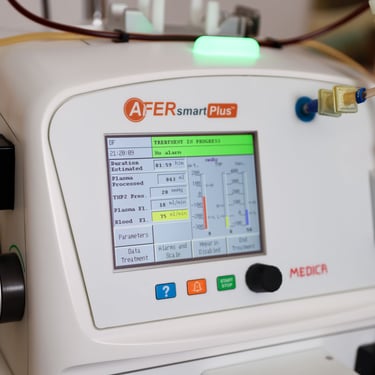
We use the newest apheresis equipment from Medica S.p.A. (Italy), equipped with multiple integrated safety sensors, and sterile single-use sets.
The patient’s blood and plasma never come into direct contact with the internal components of the apheresis machine. Instead, they circulate through a closed extracorporeal circuit consisting of sterile, single-use medical tubing and filters.
The information on this page is provided for educational purposes and does not replace individual medical advice, diagnosis or treatment. The indications, level of scientific evidence and expected benefits of therapeutic apheresis vary between diseases and individual patients. Individual medical qualification is required.